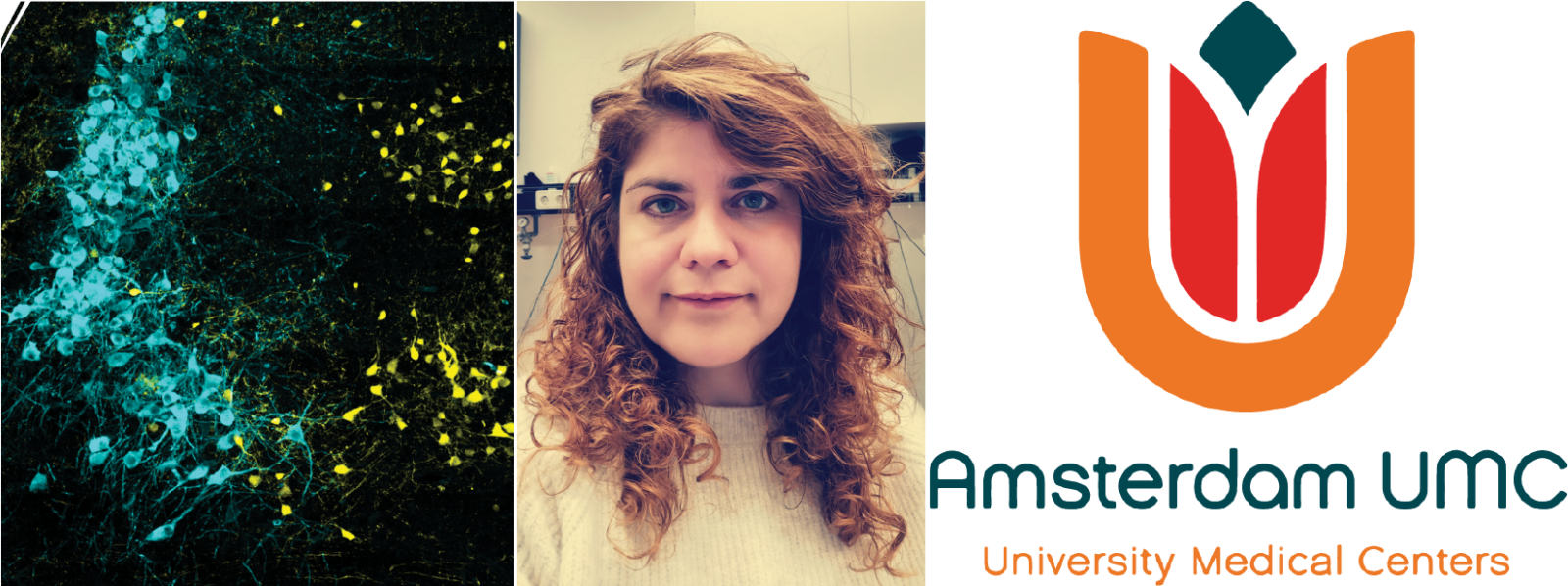
Recently BRAINSCAPES member Dr. Danai Riga was awarded the Amsterdam UMC fellowship. The fellowship (750K euro) will support here in establishing her independent research line and expand her research group. From November, Dr. Riga started her new position as team leader within the Functional Genomics (FGA) group of the CNCR. With this her official involvement in BRAINSCAPES came to an end, although her future research will further build upon findings acquired in the project. We took the opportunity to congratulate Dr. Riga and ask her a few questions.
The awarded project, titled “Should I stay or should I go? Elucidating neuropeptidergic modulation of approach-avoidance behaviour” focuses on the neurobiological mechanisms that control our responses to challenging environments. In particular, Dr. Riga’s team will work on identifying how neuromodulators, such as norepinephrine and various neuropeptides, mediate behavioural choices during negative (stressful or threatening) experiences. Taking advantage of a multilevel approach, that includes synaptic proteomics, electrophysiology and circuit manipulation in the behaving animal, Dr. Riga aims to highlight the endogenous systems that promote adaptive stress responses and prevent maladaptations linked to the development of psychopathology, including anxiety, impulse control and attentional disorders.
Dr. Riga, congratulations with this wonderful news and exciting new step in your career. Can you maybe tell where you see the consortium has given an added value?
“Being part of the consortium has brought me close to many excellent researchers, new colleagues and potential collaborators (whom I otherwise might have not had the opportunity to meet). I especially enjoyed being exposed to different techniques and scientific angles others employ to address their research questions. I find this very inspiring.”
You have made very important contributions to the BRAINSCAPES project. How will this be followed-up in the coming time?
“Although I will not be officially part of the project, I will build further upon the data that I have acquired during my time in BRAINSCAPES, and hope that this will lead to some cool & exciting science. As such, my future work is partially founded on what I have been doing in BRAINSCAPES and partially on my Veni work in Utrecht.”
For more information see Dr. Riga’s team’s page: https://cncr.nl/research-team/neuromodulation-of-cognition/.