
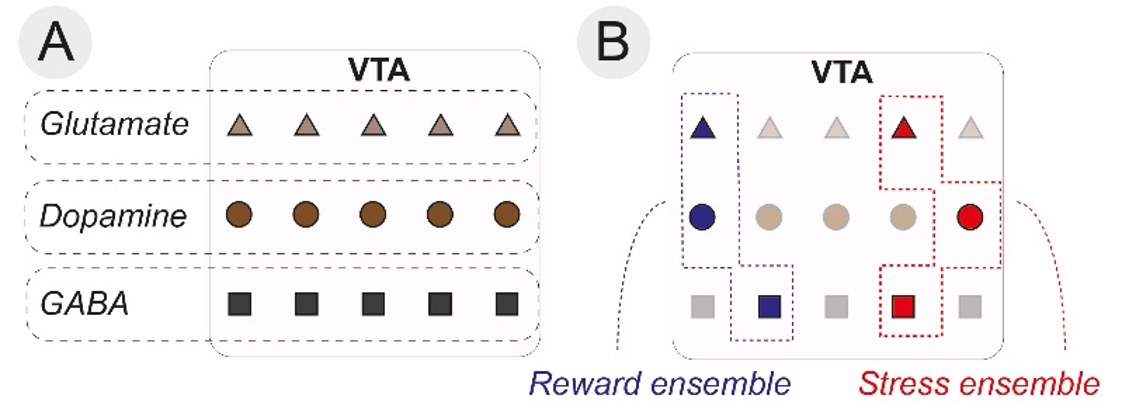
How do small groups of neurons decide whether we approach a reward or avoid a threat? In a study published April 2nd 2025 in Nature Communications, Frank Meye’s lab at UMC Utrecht shows that distinct neuronal clusters (i.e. neuronal ensembles) in the ventral tegmental area (VTA) are essential for encoding positive and negative experiences.
First author Ioannis Koutlas and colleagues used an innovative approach in transgenic mice where they tagged neurons in the VTA which, based on immediate early gene expression, had become active in response to a particular environmental stimulus. They first established that acute exposure to a rewarding opioid or to a stressful social confrontation triggered opposite behavioral outcomes (approach vs avoidance). They then showed that these two distinct experiences tagged two largely non-overlapping ensembles of neurons in the VTA. These sets were of approximately similar small size (10% of VTA neurons). Moreover, each ensemble comprised multiple neurotransmitter-defined neuronal cell types, and the compositions thereof were similar between the ensembles. This identifies that neurotransmitter-based identities are not sufficient to parse neurons in functional terms.
“Our findings shed light on the organization of the VTA into valence-specific ensembles, which is key to orchestrating adaptive behavioral responses,” says first author Ioannis Koutlas.
The researchers then stimulated or inhibited these small ensembles to assess their role in behavior. By selectively activating these groups with opto- or chemogenetics, the researchers drove strong reward-seeking (reward ensemble) or avoidance responses (stress ensemble). Instead, targeted inhibition of these small ensembles fully blocked adaptive behaviors such as stress-driven avoidance, and reward-driven approach behaviors. These experiments identify the crucial role of VTA ensembles of specific cell types in processes of aversion and reward.
Perturbations in processing such valence processes are a fundamental problem in various brain disorders. Psychiatric conditions such as eating disorders, drug addiction and depression, but also neurological disorders like dementia and Parkinson’s disease). The results from this study are therefore an important stepping stone towards understanding, with further research, which exact neuronal cell types contribute to pervasive aversion/reward problems across brain diseases.
The work was carried out in the Translational Neuroscience Department at the UMC Utrecht Brain Center. For more information, check out this link.