
A new study published in Nature Communications reveals that memory-encoding cortical neurons functionally contribute to remote memory retrieval after a mild, but not strong, aversive event.
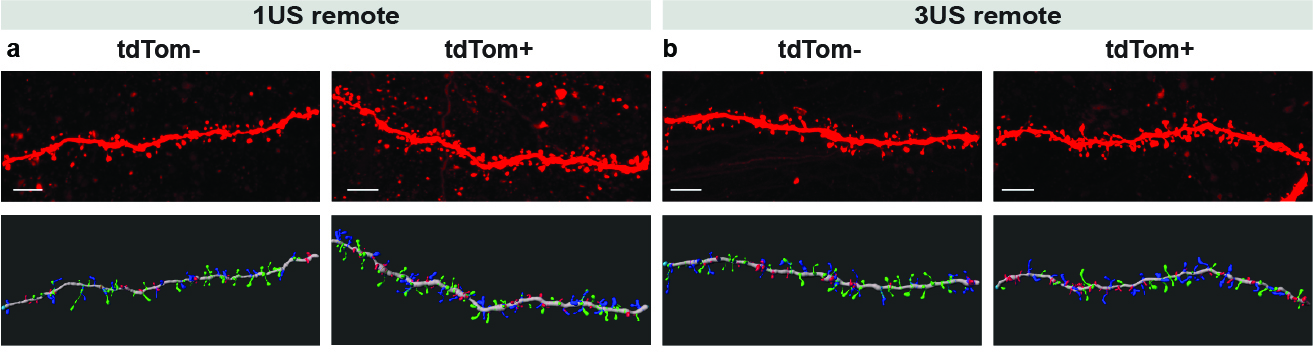
Several BRAINSCAPES members contributed to this work, including Dr. Miodrag Mitric (former member), Dr. Sanne Beerens, Pof. dr. Guus Smit, Dr. Priyanka Rao-Ruiz and Dr. Michel van den Oever. The team aimed to elucidate synaptic adaptations on cortical neurons that support the storage and expression of a persistent aversive memory. For this, mice underwent threat (fear) conditioning using 1 or 3 foot-shocks (1US – mild threat vs 3US – strong threat, respectively) and compared with mice that did not receive foot-shocks during conditioning. Neurons activated during conditioning, so-called engram cells, were genetically labelled with a fluorescent report (tdTomato) to allow visualisation and chemogenetic manipulation during memory retrieval. First, they found that cortical engram neurons are only functionally involved in remote memory expression after mild conditioning. Next, in a set of electrophysiological recordings and structural analyses of engram versus non-engram neurons, they observed that only after mild conditioning, cortical engram neurons show a time-dependent increase in the density of long thin spines on their oblique dendrites, aligning with their causal contribution to memory persistence.
Together, this study demonstrates that synaptic adaptations in cortical engram cells exhibit three key characteristics: they depend on (1) threat intensity, (2) the passage of time, and (3) develop in a dendritic segment-specific manner. As such, these findings provide strong support for (1) the functional engagement of cortical engram cells in expression of a mild threat memory, (2) their contribution to remote, but not recent, memory expression, and (3) increased potential for enhanced connectivity with afferents innervating oblique dendrites of these memory-encoding cortical neurons.
Next, the BRAINSCAPES team will investigate the synaptic proteome of cortical engram cells and determine whether GWAS-identified risk genes of post-traumatic stress disorder and anxiety disorders are differentially expressed and/or enriched in these specific neurons.
Source: Threat intensity shapes cortical engram architecture supporting remote memory retrieval. Nature Commun 2026 Jun 11. DOI: 10.1038/s41467-026-74231-5