
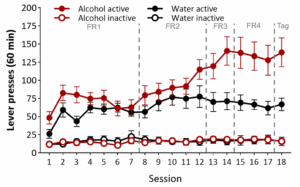
 Mice (TRAP2-tdTomato; n = 24) were trained in an operant self-administration paradigm to perform a lever-press action to obtain a liquid reward (alcohol or water). During reward delivery, a cue light was presented to establish an association between the reward and the cue. On the final training session, neurons activated during operant self-administration were tagged via Tamoxifen (4-OHT) administration, enabling persistent fluorescent labeling with tdTomato. Medial prefrontal cortices were subsequently isolated to characterize the synaptic proteomic profile of these self-administration-activated neurons.
Additional available data: homecage alcohol & water consumption (2-bottle choice & limited access), operant consumption, latency to first lever press and efficiency score.
Access: behavioural data is available upon request.